
Editorial — October 18, 2026. A purchase limit is supposed to give ordinary fans a fair chance. But a rule that stops one person after four or eight tickets while an industrial reseller can manufacture thousands of buyer identities is not really a limit. It is a speed bump for honest customers.
A federal lawsuit filed October 15 makes the scale of that problem unusually visible. The Federal Trade Commission and Justice Department allege that ticket broker REPS & Company and three executives circumvented purchase controls used by Ticketmaster, AXS and other issuers. The defendants have not been found liable, and the allegations will be decided by a court.
According to the filed complaint, the defendants purchased more than 18.6 million tickets through more than 3.1 million transactions since 2022. At at least 83,500 events, they allegedly bought more than eight tickets, spending over $1.3 billion to acquire more than 18.5 million tickets for those events and earning at least $120.8 million in secondary-market profit.
The alleged machinery was bigger than a bot
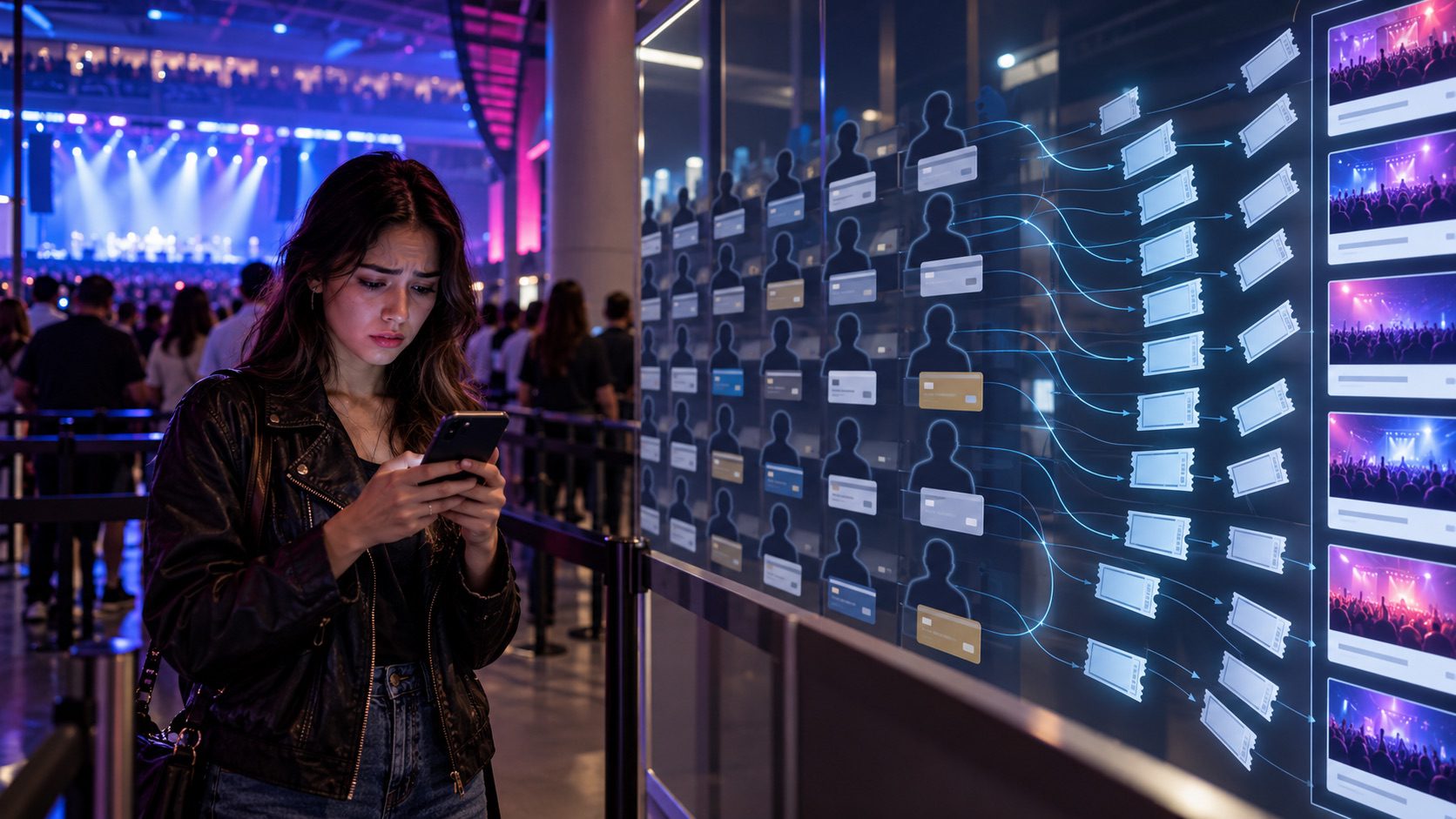
It is tempting to picture ticket abuse as one script hammering a checkout page. The government describes something broader: purchasing teams, thousands of issuer accounts created with employee or third-party identities, virtual credit cards and phone numbers, proxy or VPN addresses, and multi-session browsers used to obscure identity and location.
Ticket issuers already compare accounts, cards, emails, phone numbers and IP addresses. The complaint alleges that when purchases were blocked, small changes to a name or address could become part of the workaround. It also says analytics, scraping and secondary-market trends helped identify high-demand events where resale prices were likely to rise.
That is the central design failure. Account-level enforcement assumes an account roughly represents a buyer. At industrial scale, accounts become disposable packaging. Every additional field can be synthesized, rented or varied until the system sees a crowd of unrelated customers instead of one coordinated operation.
Fair access needs purchaser-level signals
Platforms need to measure coordinated purchasing without turning every concert ticket into an identity checkpoint. That means combining proportionate signals—payment relationships, device and network patterns, purchase timing, transfer behaviour and repeated resale destinations—rather than treating any one account credential as proof of independence.
Stronger checks should be triggered by suspicious scale, not imposed on every fan. A person buying two seats should not have to surrender a government ID because a broker runs a warehouse of accounts. Data should be minimized, retained for limited periods and protected by clear appeal processes when legitimate households or shared networks are caught by mistake.
Issuers and resale marketplaces also need a shared view of provenance. A ticket’s transfer history does not have to expose the buyer publicly, but the marketplace accepting it for resale should be able to determine whether the original purchase exceeded a posted limit or came from a cluster already flagged for circumvention. Enforcement that ends at checkout merely moves the profit opportunity downstream.
The rule must follow the operation
The Better Online Ticket Sales Act covers circumvention of technological controls used to enforce posted ticket limits and the knowing resale of tickets obtained through that circumvention. Reselling a ticket is not automatically illegal, and the current case is not proof that every secondary marketplace or broker behaves the same way. It does show why enforcement cannot be reduced to a CAPTCHA and a per-account counter.
The Justice Department is seeking an injunction, monetary relief and civil penalties. Whatever the court ultimately decides about these defendants, the alleged methods should be treated as a product-design warning.
A fair queue needs to recognize coordinated purchasing as one operation while preserving privacy for ordinary fans. Until ticket limits can follow the buyer behind the accounts—or make mass circumvention unprofitable—the people most likely to obey the rules will remain the people those rules restrain.
Sources
- Federal Trade Commission: complaint announcement (October 15, 2026)
- United States v. REPS & Company: filed civil complaint (October 15, 2026)
- U.S. Justice Department: complaint announcement (October 15, 2026)