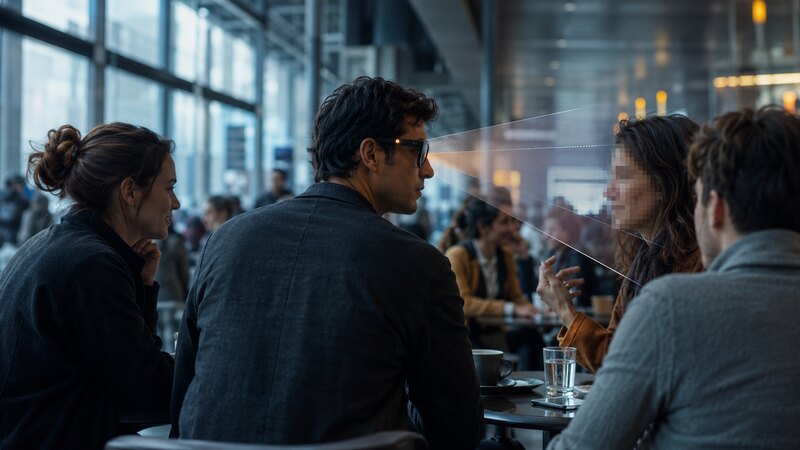
Imagine sitting across from someone in a café.
They look at you while you speak. Nothing unusual there. Looking at another person is one of the basic pieces of human conversation. It signals attention, curiosity or, depending on the conversation, a heroic effort not to check a phone.
Now add a camera to the glasses on their face.
The physical scene barely changes. They do not lift a phone, aim a lens or hold a screen between you. They keep looking. Yet that ordinary act may now mean something completely different: your face, voice and half-finished sentence could be captured from less than a metre away.
You may notice a tiny light on the frame. You may know what it means. You may be sitting at the correct angle to see it. Those are three separate maybes standing between a private moment and a shareable video.
That is the real privacy problem with smart glasses. It is not simply that another consumer device contains a camera. Cameras are already everywhere. It is that the device removes the familiar social gesture of using one.
Phones never guaranteed consent, but they usually made recording legible. Someone had to take the device out, raise it and point it. The subject could turn away, lower their voice, object or leave. Smart glasses can collapse all of that warning into a pinprick of light beside a person’s eye.
This week, Australia’s eSafety Commissioner Julie Inman Grant argued that smart glasses should provide unmistakable recording signals and automatically blur bystanders’ faces. It is a striking proposal because it asks manufacturers to consider someone who never bought, configured or agreed to use the product.
That person—the stranger on the other side of the lens—has been the missing customer in wearable technology for more than a decade.
The camera lost its gesture
Canada’s privacy regulator saw the problem remarkably early.
In 2014, during the first wave of Google Glass enthusiasm, the Office of the Privacy Commissioner warned that wearables could collect images, audio and video in unobtrusive ways, including in situations where a more obvious camera would be socially unacceptable.
That observation has aged better than the hardware it described.
Google Glass was visibly technological. Its small display sat in front of the wearer’s eye like a computer had parked on their eyebrow. People might not have known exactly what it was doing, but they knew it was doing something. The design announced itself, and the social backlash became part of the product’s identity.
The new generation solved that problem by becoming less noticeable.
Modern camera glasses are sold through familiar eyewear brands and designed to resemble ordinary frames. The camera and microphone remain, but the “computer on your face” aesthetic has largely disappeared. That has made the devices easier to wear, easier to sell and much harder for everyone nearby to interpret.
This is no longer a niche thought experiment. Counterpoint Research reported that global smart-glasses shipments grew 110 percent year over year during the first half of 2025. AI-equipped models made up 78 percent of shipments, and Meta held 73 percent of the overall market during that period. The research firm expected growth to continue through 2026 and beyond.
The industry’s success therefore depends on a peculiar achievement: putting increasingly capable sensors in public spaces while making the device carrying them feel ordinary.
Ordinary is wonderful for the wearer. It is unnerving for everybody else.
A conventional camera has a readable state. It is on the table, hanging from a strap or raised toward a subject. A phone can be ambiguous, but posture supplies clues. Camera glasses turn the wearer’s natural field of view into the camera’s field of view. The only reliable way to avoid the lens may be to avoid the person.
[AD PLACEMENT]
That changes behaviour even when nobody is recording. Once the possibility becomes common enough, every pair of thick-framed glasses can create a small question: is this conversation still just a conversation?
Privacy is not only the prevention of harmful files. It is also the freedom to act naturally without constantly auditing the objects around you.
A warning light is not a social contract
Meta deserves credit for acknowledging that the recording indicator cannot be optional.
The first Ray-Ban Stories glasses included a front capture light intended to alert people when a photo or video was being taken. This month Meta went further. After people found ways to conceal the indicator, the company updated its glasses so the camera stops recording when the light is obstructed. It also began a public campaign explaining what the indicator means, according to The Verge’s August 27 report.
That is sensible engineering. A warning system that can be defeated with a small piece of tape is not much of a warning system.
It is not, however, the same as meaningful notice.
A light works only if it is visible from where a bystander is standing, distinguishable in daylight, understood by the person who sees it and noticed before the moment they would have chosen not to share. It tells people that some form of capture is happening, but not whether audio is included, how long recording has been underway, where the file will go or whether an AI system is analysing the scene.
The wearer knows the device’s state because they initiated it. The bystander receives a tiny clue.
Researchers describe this as more than a manners problem. A 2026 CHI study surveyed 525 people and conducted 20 paired interviews about camera-glasses privacy. It found a persistent gap between the protections bystanders expected and what wearers were willing to provide. In sensitive settings, 65 to 90 percent of bystanders said they would take defensive action. The authors concluded that the tensions were structural and recommended protections that change with context.
That word—structural—matters.
Most owners will not use smart glasses to harass anybody. Many will record exactly as responsibly as they would with a phone. But good intentions cannot communicate a device state that other people cannot see. A polite wearer and a predatory one may look identical from across the room.
This is why etiquette alone cannot carry the whole burden. “Ask before recording” is a good rule, but products should not become dangerously opaque the moment somebody ignores it.
Venues are already building their own answers. Brisbane moved to prohibit covert filming devices at its public pools. Courts in England, Wales and New York have restricted smart glasses. Burning Man’s 2026 guidance explicitly tells attendees to obtain permission from anyone who may appear in the frame, including people in the background.
Those rules make sense in places where vulnerability, confidential information or personal expression raises the stakes. They also reveal the weakness of leaving every library, courtroom, workplace, pool and concert venue to invent a separate smart-glasses constitution at the door.
[AD PLACEMENT]
When a new category requires everyone else to post signs explaining when it is socially acceptable, the product is exporting part of its design problem into the physical world.
The useful camera and the dangerous one
A blanket ban would be simple. It would also discard some genuinely valuable technology.
For blind and low-vision users, a hands-free camera can function as a layer of visual assistance. Meta’s glasses can describe surroundings and read text aloud. Through Be My Eyes, users in Canada and other supported countries can connect to a sighted volunteer who sees the wearer’s point of view and helps with tasks such as reading fine print or adjusting an appliance.
In that context, a camera built into ordinary glasses is not a novelty or a shortcut to social content. It can increase independence while leaving both hands available for a cane, guide dog, groceries or the task itself.
That benefit complicates the privacy argument in a useful way. The question cannot simply be whether glasses are allowed to see. The more important questions are what kind of seeing is happening, what is retained and what can leave the device.
Live visual assistance is not identical to saving a video. Analysing text long enough to read a sign aloud is not identical to uploading a stranger’s face. A volunteer briefly viewing the wearer’s surroundings during an intentional support call is not identical to an always-growing archive.
Current products and laws often flatten these very different activities into the broad category of “camera use.” Better design could separate them.
A device might process a scene for navigation or description without creating a permanent recording. Stored or shared footage could blur unfamiliar faces by default. Sensitive locations could trigger stronger protections, while a deliberate recording mode could use a much clearer outward signal than a small LED. Users who need an unblurred record for journalism, safety or evidence could have a documented way to preserve it rather than a silent default that treats every nearby face as content.
Automatic blurring is not flawless. Software misses faces, obscures the wrong objects and can strip useful context from legitimate documentation. A protest, accident or act of misconduct may need an accurate record. A system that lets the wearer casually remove every blur would also provide very little protection.
These are real trade-offs, not reasons to abandon the idea.
The important shift is deciding that bystander privacy belongs in the technical specification. At present, most privacy settings protect the owner’s account, recordings and cloud data. Those controls matter, but they protect the person who purchased the glasses. The people being sensed receive no settings screen at all.
Design for the person outside the frame
Canadian law illustrates why product design matters.
Businesses using video surveillance can face consent and reasonableness requirements under private-sector privacy laws. The Criminal Code also prohibits certain surreptitious recordings where a person has a reasonable expectation of privacy, including the circumstances set out in section 162. But an ordinary encounter in public can fall into a broad space governed by context, provincial rules, platform policies, venue conditions and social expectations rather than one simple national prohibition.
The law can address particular harms. It is much worse at restoring the small moment of understanding that disappeared when the camera moved onto the face.
Manufacturers can help rebuild that understanding.
Recording indicators should be bright, standardized and visible from more than one narrow angle. A physical privacy state should be obvious to nearby people, not merely confirmed inside the wearer’s app. Devices should distinguish temporary visual processing from recording and from sharing. Face protection should be strongest by default in sensitive contexts, and product testing should include bystanders who have no reason to recognize a proprietary light pattern.
Regulators, meanwhile, can set minimum design requirements before a dozen incompatible signals become normal. The Australian proposal for automatic face blurring may not be the final answer, but it begins in the right place: the burden should not rest entirely on a stranger noticing, understanding and confronting someone who may already be filming them.
[AD PLACEMENT]
There is a tendency in consumer technology to call misuse an edge case right up until the product becomes popular. Then the edge case is suddenly standing in every café, school hallway and waiting room.
Smart glasses may become one of the most useful forms of personal computing. They can offer translation, navigation, memory, accessibility and assistance without forcing people to stare down at another screen. The same qualities that make them powerful—their point of view, persistence and near invisibility—also make their privacy failures unusually intimate.
The industry does not have to choose between useful glasses and private public spaces. It does have to stop pretending that the wearer is the only person using the product.
Every camera creates two sides: the person choosing to capture and the person who may be captured. Phones made that relationship imperfect but visible. Smart glasses have made it elegant but obscure.
If this technology is going to sit naturally on millions of faces, the people standing in front of it need a natural way to understand what is happening.
A look should still be allowed to mean only a look.