
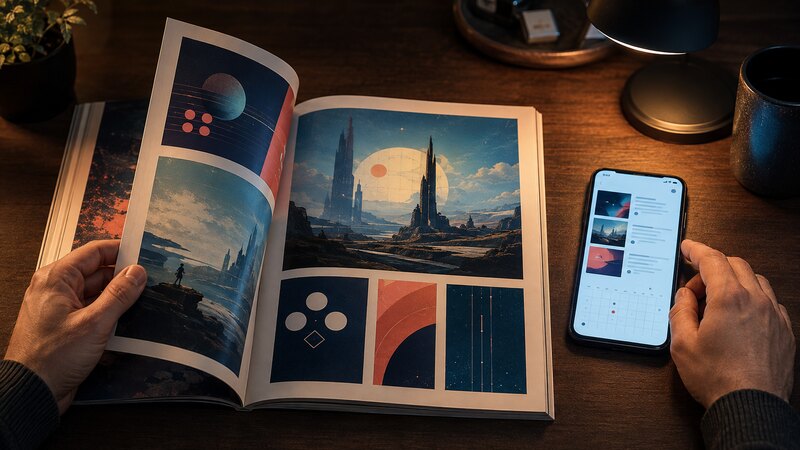
Game Informer has just launched a mobile app and expanded its print subscriptions internationally in the same week.
At first glance, those announcements appear to be pulling in opposite directions. One puts decades of gaming coverage on the slab of glass already in your pocket. The other asks Canadians and readers across dozens of countries to pay for dead trees delivered by a person in a truck.
Together, though, they make considerably more sense than either one would alone.
The future of a gaming magazine probably is not choosing between paper and a screen. It is giving each one a different job.
On August 27, Game Informer released an iOS and Android app containing its news, reviews, videos, release calendar and digital magazine. Subscribers can also browse an archive dating to 1991, now more than 380 issues deep. Three days earlier, the publication opened print subscriptions beyond the United States, including Canada, the United Kingdom, much of Europe and several other markets.
This is happening as Game Informer celebrates its 35th anniversary. More remarkably, it is happening barely two years after the magazine appeared to be finished.
A magazine that already had an ending
GameStop abruptly closed Game Informer in August 2024 after 33 years and laid off its staff. As The Verge reported at the time, the website was replaced by a farewell notice, taking years of online work with it.
Then came an unusually complete resurrection. Gunzilla Games acquired the publication, the website and archive returned, and the team working there at the time of closure was rehired. Editor-in-chief Matt Miller said in the March 2025 relaunch announcement that Game Informer would operate as an independent editorial outlet under a separate company.
The new subscription model is not simply an attempt to restart the old machine. Game Informer now describes its physical edition as a 100-page premium magazine with improved paper and cover stock, published ten times a year. The upcoming anniversary issue includes a retrospective on notable covers and a poster—details designed to make an issue feel less like a temporary container for news and more like an object.
That change matters because paper has decisively lost its old job.
A monthly magazine cannot tell readers what happened today faster than a website, app, video channel, social feed or group chat. By the time a release date, delay or studio announcement reaches a mailbox, it may already have been corrected, argued over and converted into three different memes.
[AD PLACEMENT]
But speed is not the only reason people read about games.
Players also want art worth lingering over, interviews with room to breathe, criticism that survives launch week and a record of what the medium looked like at a particular moment. A good print issue can do those things without pretending to be breaking news printed four weeks late.
The phone is the tool; the magazine is the artifact
Game Informer’s app handles the practical side of the relationship. Its release calendar is updated daily and can be sorted and organized. Stories and issues can be saved for later. The company also says the app is algorithm-free, meaning readers choose what to follow instead of being fed whatever a recommendation system predicts will keep a thumb moving.
That is a quietly appealing pitch. The app offers the convenience of a feed without entirely behaving like one.
Print, meanwhile, can offer what the phone cannot: edges, weight, scale and an ending. A magazine does not refresh while you read it. It does not place a notification over the best paragraph. When you reach the back cover, you are done—a surprisingly luxurious experience in 2026.
This does not amount to a mass-market print revival. Plenty of magazines continue to lose circulation, and international shipping will make Game Informer an indulgence for some readers. The audience for a premium gaming magazine is almost certainly smaller than the audience that once received copies through a retailer’s loyalty program.
Smaller can still be sustainable if the product means more to each person buying it.
That pattern is visible outside games. When fashion magazine i-D returned to print in 2025, The Guardian documented growing interest in magazines as tangible, collectible objects even while much of the mass market remained under pressure. The important word is not “revival.” It is “repositioning.” Paper is moving from the default way to receive information to the special way to keep it.
[AD PLACEMENT]
Gaming is unusually well suited to that shift. The medium is intensely visual, its audience already collects physical editions, art books and hardware, and its history is often remembered through covers and screenshots. An old issue is not merely yesterday’s news. It is evidence of what people expected from a game before patches, sequels and hindsight changed the story.
There are reasonable doubts around Game Informer’s model. Its owner is also a game developer, even with promises of editorial independence. Premium publishing is expensive. Nostalgia can persuade someone to buy an anniversary issue without turning them into a long-term subscriber.
Still, the app-and-print strategy answers a more interesting question than whether magazines are “back.” It asks what a magazine is for when nobody needs it to deliver news.
Game Informer’s answer is refreshingly practical. Put the calendar on the phone. Put the archive everywhere. Put the thing worth keeping on paper.
The magazine did not return by turning back the clock. It returned because the clock finally stopped being its competition.

