The funniest thing about Apple’s first folding phone is how little folding it has to explain.
Samsung, Huawei, Motorola and several other manufacturers have already spent years teaching people what the hinge does, why the screen has a crease and which pocket can accommodate a small electronic paperback. Early buyers supplied the enthusiasm. Reviewers supplied the warnings. Rival engineers supplied the expensive lessons.
Apple arrived after the vocabulary was established and announced the iPhone Duo as though the category had been waiting in the lobby.
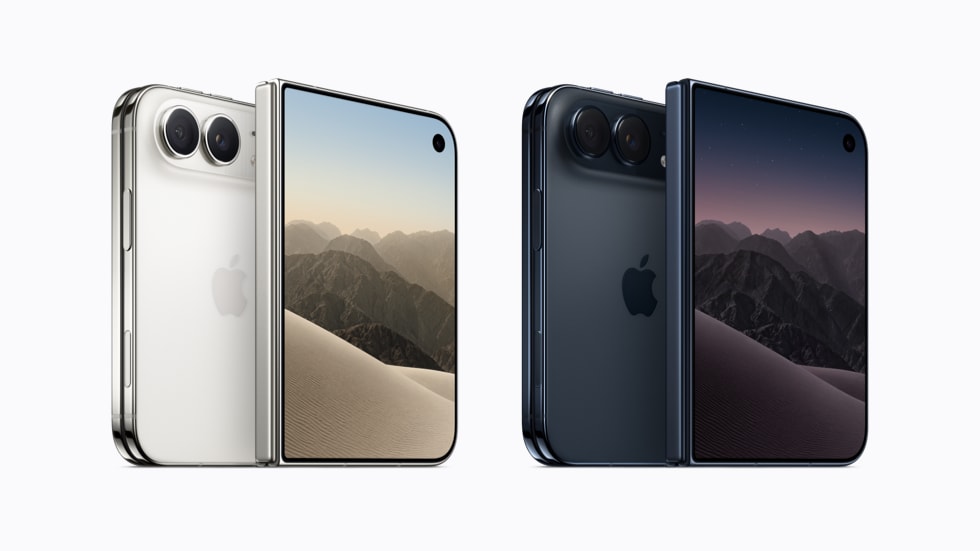
Unveiled on September 9, the Duo has a 5.4-inch outer screen and opens into a 7.6-inch inner display. It starts at US$1,999 for 256GB, with preorders beginning October 16 and availability in Canada and more than 70 other markets on October 23. Apple’s announcement emphasizes a titanium body, IP68 water and dust resistance, a hinge assembled from more than 100 components and a matte inner surface designed to make the crease less noticeable.
That is serious engineering. It is also the luxury version of showing up after somebody else has found all the loose floorboards.
The first generation happened somewhere else
Foldable phones did not begin as polished little tablets that happen to accept calls.
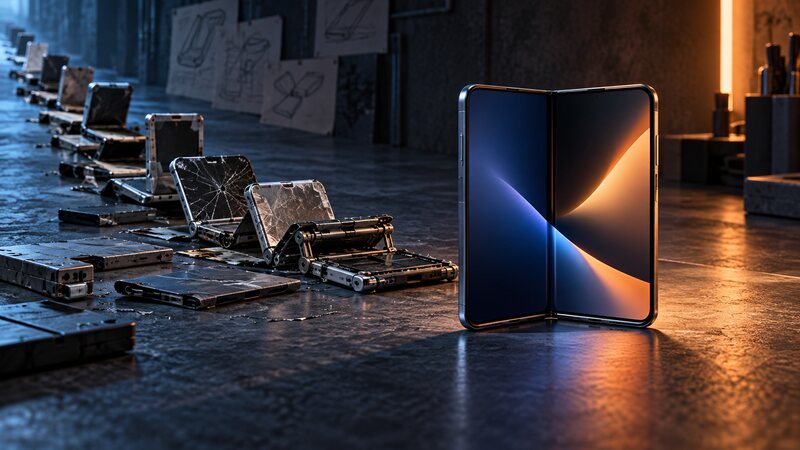
Royole shipped the FlexPai in 2018, a device remembered less for changing communication than for demonstrating that a screen could bend while the rest of the product remained deeply unconvinced. Samsung followed with the original Galaxy Fold in 2019. Review units suffered display failures, some after people removed a protective layer that looked remarkably like something people were supposed to remove. Samsung delayed the launch and retrieved the devices.
That embarrassing period was not wasted. It was research conducted in public.
Over the following years, manufacturers tested book-style phones, clamshells, outward folds and even three-panel designs. Hinges became thinner. Creases became less dramatic. Software slowly learned that opening a phone should do more than make the same app unusually wide.
Reuters’ history of the category describes the trade-offs that kept foldables niche: weaker cameras, shorter battery life, awkward centre creases and prices that made experimentation feel like a financing decision. Foldables still represent only a small share of global smartphones, even though Samsung now holds roughly 40 percent of that segment and Huawei about 30 percent.
Apple had the rare privilege of watching all of this without asking its customers to participate.
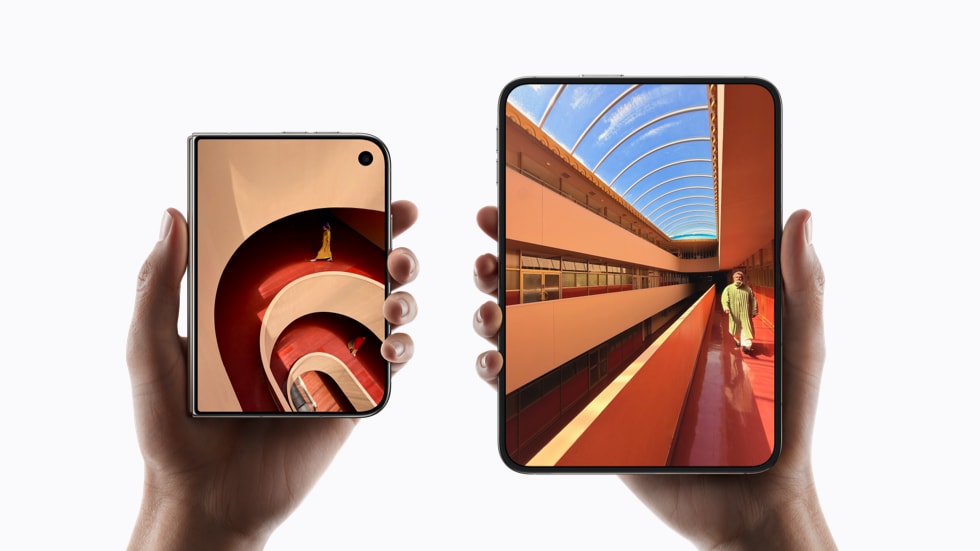
The Duo borrows the now-established passport shape: compact when closed, wider when open and better suited to video than the tall, narrow inner screens of some earlier models. It uses Touch ID in the side button rather than squeezing Face ID hardware into the design. Its two rear cameras are capable, though it gives up the more elaborate camera system buyers might expect from a conventional phone at this price.
Those are not signs that Apple copied a finished answer. They are signs that the questions are finally specific enough to answer.
Apple is selling confidence, not surprise
The cleverest part of the Duo may be that Apple has made the fold feel like a normal iPhone behaviour.
iOS 27 can place two apps side by side, save app pairs and adapt controls as the screen changes shape. Apps expand gradually as the phone opens instead of abruptly jumping between displays. StandBy works when the device is propped like a tent, and Apple Pencil support is promised later this year.
In a brief hands-on, The Verge found the hinge smooth and the crease nearly impossible to feel. That is encouraging, though a few minutes at a launch event cannot tell us what the inner screen looks like after a Canadian winter, a year of pocket grit and several thousand impatient openings.
Durability claims deserve particular caution because the inner display remains a moving part with layers designed to flex. Apple says custom adhesives let those layers slide past one another like pages in a book. It says the polymer cover is stiffer than materials commonly used elsewhere in the industry. Those are meaningful specifications, but only long-term use can turn them into trust.
That trust is exactly what Apple expects buyers to pay for.
The iPhone Duo does not compete only through screen size. A person spending two thousand US dollars on a first-generation design is buying the expectation that Apple has already absorbed the first-generation pain. The company’s brand converts lateness into reassurance: yes, this is new, but it is new in a way that should behave normally.
That strategy has worked before. Apple did not invent the portable music player, smartphone, tablet, smartwatch or mixed-reality headset. Its signature move is to enter an existing category, discard some of its stranger conventions and present the remaining idea as a coherent product rather than a technical demonstration.
Sometimes that creates a mass market. Sometimes it creates an extremely polished niche. A folding iPhone is not guaranteed to make foldables ordinary simply because Apple sells one.
The market remains skeptical. WIRED reports that an IDC survey found 60 percent of respondents were unlikely to consider a foldable at their next upgrade. Yet almost one-third said they absolutely would if Apple released one. That gap is the entire bet: the barrier may not be the hinge anymore. It may be confidence in who built it.
The Duo also gives Apple a convenient new ceiling for phone pricing. It sits above the Pro models without requiring buyers to believe a slightly better camera is worth another enormous jump. The physical transformation is visible. Open it at a table and nobody needs a benchmark chart to understand why it costs more.
For rivals, this is both flattering and irritating. Years of Android foldables proved the category could survive, improved the supply chain and trained the audience. Apple now gets to sell the moment when the experiment becomes respectable.
That does not make the iPhone Duo unoriginal. It makes its originality unusually dependent on other companies having gone first.
The folding phone’s awkward adolescence happened in public. Apple skipped the school photos and arrived just in time for graduation.