
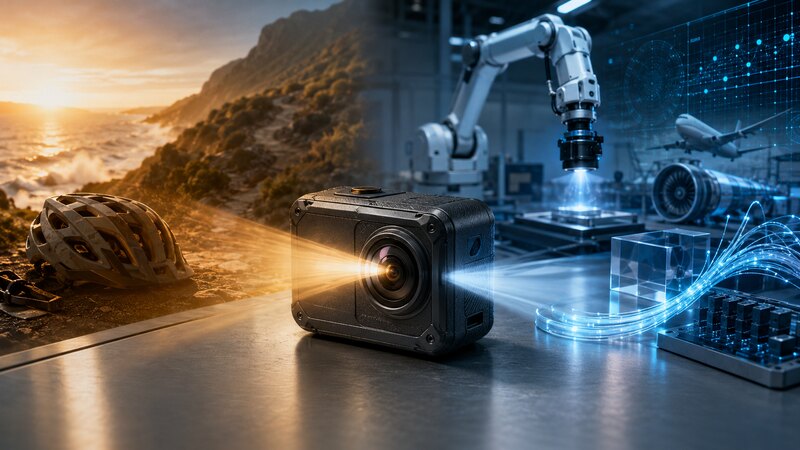
For most of its life, GoPro sold a wonderfully simple fantasy: strap this little camera to something moving quickly and return with proof that you are more interesting than your neighbours.
Surfboards, bike helmets, dogs, drones and mildly inadvisable vacations all became part of the brand. GoPro did not merely sell imaging hardware. It sold the possibility that Tuesday’s trail ride might deserve its own highlight reel.
Now the action-camera company is preparing for a rather different adventure: AI data centres, government work, robotics, aerospace and defence.
On September 1, GoPro announced a definitive merger agreement with Starman Optical, a privately held American optical-photonics company. GoPro shareholders are due to receive an aggregate $285 million in cash and retain roughly 10 per cent of the combined public company. Approximately $92 million in GoPro debt is expected to be repaid when the deal closes.
The consumer cameras are not being discontinued. GoPro says it will continue supporting its products, subscription service and cloud platform.
But the language surrounding the deal makes the new priority difficult to miss. The combined company wants to use GoPro’s optics, imaging expertise and portfolio of more than 2,500 US patents in markets far removed from the ski hill.
The interesting part is not that GoPro has found a buyer. It is what the buyer appears to believe it bought.
A brand can fade while its technology keeps working
GoPro was one of those rare products that became the generic name for an entire category. That cultural position did not guarantee an easy business.
Smartphone cameras improved. DJI and Insta360 became formidable competitors. People who already owned a perfectly adequate action camera did not necessarily need another one every year. A rugged little box can record someone jumping off a cliff for a long time before the owner feels compelled to upgrade it.
GoPro’s own numbers show the pressure. The company reported 2025 revenue of $652 million, down 19 per cent from the previous year, while camera sell-through fell 20 per cent to about two million units. In May, the company began reviewing strategic options including a possible sale or merger. Reuters reported that this followed an earlier effort to find defence and aerospace opportunities for its technology.
That chronology matters. Defence is not a theme somebody added to the merger announcement at the last minute. GoPro had already started looking beyond the consumer shelf.
[AD PLACEMENT]
Starman brings a different business into the combination: optical transceivers, which allow networking equipment to send data using light. Those components have little in common with filming a mountain-bike descent from the rider’s forehead, but they belong to the same broader world of optics, sensing and moving enormous amounts of visual or digital information reliably.
The merger therefore treats GoPro less like a finished consumer-electronics story and more like a technical parts bin with a famous name attached.
That is not meant dismissively. Building cameras that are small, rugged, power-conscious and capable of producing stable images in terrible conditions is valuable knowledge. Robots also need to see while vibrating. Industrial systems need compact sensors. Aircraft do not enjoy perfect studio lighting.
The skills developed to survive an ocean wave can remain useful even when the camera is no longer pointed at a surfer.
The uncomfortable second life of consumer hardware
There is an odd emotional gap between the GoPro people know and the company described in Tuesday’s announcement.
Consumer technology is usually marketed through identity. A camera promises creativity or adventure. A laptop promises productivity. A drone promises a new perspective. The machinery becomes friendly because advertising places it in familiar human stories.
Industrial and government buyers do not need the story. They care about durability, optics, latency, manufacturing and intellectual property. The cheerful lifestyle brand can become almost incidental.
That transition is not automatically sinister. Cameras inspect bridges, guide warehouse robots, support search-and-rescue equipment and help aircraft operate safely. “Government” and “aerospace” cover far more than weapons. The merger announcement does not specify particular defence products, and it would be irresponsible to invent them.
Still, the move deserves more thought than the usual corporate language about “adjacent markets.” Technology built for play can acquire more serious purposes once the consumer business weakens. The same tiny, stabilized eye that records a family kayaking trip may also be attractive anywhere a machine needs vision in a harsh environment.
[AD PLACEMENT]
For current GoPro owners, the immediate message is reassuring. The company says products and support will continue, and The Verge notes that GoPro intends to remain publicly listed. A stronger balance sheet could even give its consumer-camera roadmap more room than it had under mounting debt and shrinking sales.
The risk is that “continue supporting consumers” eventually means maintaining the familiar business while investment and ambition migrate elsewhere. High-margin contracts and AI-infrastructure spending can make the retail camera feel like the charming front room of a much larger building.
Perhaps that is what survival looks like for a mature gadget company. The product that made GoPro famous no longer has to carry the entire company if the knowledge inside it can travel.
GoPro spent two decades teaching ordinary people to point a camera at themselves. Its next chapter may be about teaching machines to look outward.