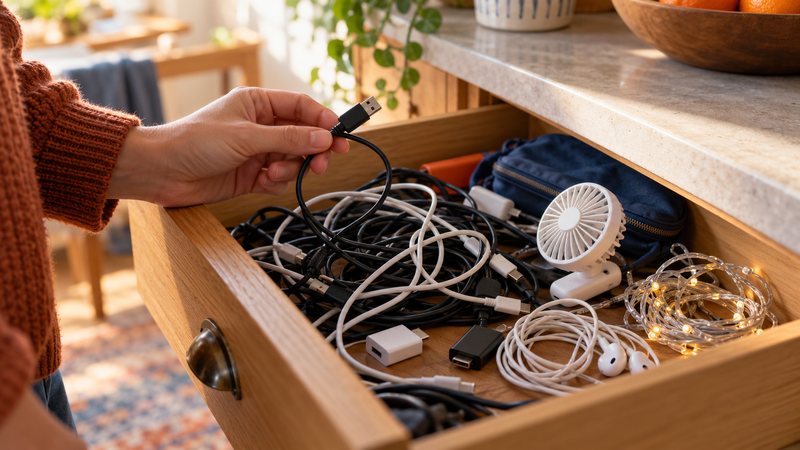
There is a particular drawer where technology goes to await a decision. Inside: a cable with an unfamiliar end, earbuds that worked better on one side, and a tiny gadget whose original purpose now feels like a group project. Nothing looks important enough to deserve a special trip. Nothing quite belongs in the rubbish, either. So the drawer gets another resident.
That halfway house is a useful place to think about “fast tech,” the focus of International E-Waste Day on October 14, 2026. The WEEE Forum, which runs the campaign, is drawing attention to small, inexpensive electronics: earphones, adapters, decorative lights, mini fans and other easily overlooked purchases. The comparison with fast fashion is deliberate. Low prices can encourage us to treat manufactured things as passing moments.
A phone usually gets a proper retirement discussion. Can it be sold? Will someone in the family use it? Is the trade-in worth anything? A cheap accessory is more likely to receive the administrative attention normally reserved for a dried-up pen. Its purchase price becomes a rough estimate of how much thought we owe it afterwards.
That is the assumption worth challenging. Affordable technology is useful, and plenty of inexpensive products do their jobs for years. The trouble starts when “cheap to buy” quietly turns into “too insignificant to keep track of.” The materials do not become less real because the checkout total was small.
The price tag leaves things out
Consider the logic of an impulse gadget. A small fan promises to make a hot desk tolerable. A novelty light promises a better-looking room. An adapter promises to solve a problem that might exist somewhere in the house. Each offer is modest enough to slip past the questions we would ask before buying a laptop. Will this actually fit my setup? What happens if one part fails? Do I already own something that does the same job?
The awkward cost often arrives later, in time rather than money. Someone has to identify the cable, test the device, find its accessories and work out where it belongs. A product that was effortless to acquire becomes a minor research assignment to get rid of. Put enough of those assignments in a drawer and postponement starts to look sensible.
The scale outside the drawer is harder to dismiss. The Global E-waste Monitor 2024, from ITU and UNITAR, reported 62 million tonnes of electronic waste worldwide in 2022. Only 22.3 per cent was documented as formally collected and recycled. Those are figures for all e-waste, not a measurement of today's cheap-gadget market, but they show why small electronics need an actual destination.
Even then, recycling should not become a polite way of saying we are finished thinking about a product. Reporting from Energy Live News on October 5 described University of Surrey research calling for repair services to have a formal role in the UK's electronic-waste system. The researchers' central concern was that useful devices can be treated as waste before their other possibilities are properly considered.
There is a difference between an object being unwanted, broken and beyond use. A spare cable that still serves a device is a spare, not a moral failing. A working gadget someone else actually wants can have another owner. The goal is to make a decision about what is there, rather than perform a dramatic clear-out and replace the collection six months later.
Make the exit as easy as the checkout
In British Columbia, there are practical starting points. Recycle My Electronics' accepted-products list includes headphones and portable audio equipment, among many other categories. The Recycling Council of B.C.'s electronics guidance points residents towards local drop-off options through Recyclepedia and its recycling hotline, including help with items outside the provincial electronics program. Check the particular item and collection location before making the trip; one depot is not automatically the destination for everything electrical.
That might sound like a lot of bureaucracy for a pair of earbuds. Which is precisely why the burden should not end with the person standing over the drawer. Retailers are very good at helping us find the next accessory. It would be welcome if they put comparable effort into explaining what happens to the previous one, in language that does not require knowing which recycling category it belongs to.
Manufacturers have a part to play before disposal even enters the picture. Clear model numbers, identifiable cables and accessible replacement parts are unglamorous features with long afterlives. They help a product remain understandable after the packaging has gone. A gadget should not become a mystery object simply because its owner has forgotten the name of the listing it came from.
For buyers, the most useful question may be smaller than “Is this sustainable?” Ask where the thing will live and what regular job it will do. That does not mean every purchase needs a spreadsheet, or that fun has to justify itself to an auditor. It means giving an accessory the same moment of consideration we would give a tool we expect to find again.
October 14 is a reasonable excuse to open the drawer. Keep the useful things, find willing homes for working extras, and identify the right collection route for items at the end of their lives. Leave enough room to see what remains. The next time a little gadget offers to improve your life, it might help to remember that it is also applying for a place in your home.