Somewhere along the way, the box became rubbish.
Not immediately, of course. First it was the thing you studied on the way home: the screenshots, the impossible promises, the system requirements that might or might not describe your computer. Then it sat beside the desk. Eventually, during a move or an ambitious cupboard cleanout, it became an awkwardly shaped item containing mostly air.
The discs stayed. Perhaps the manual did too. The cardboard lost its case.
Now a digital game shop is offering to help people reconstruct it. That sounds like a punchline about nostalgia until you consider what the empty space around a game actually contains.
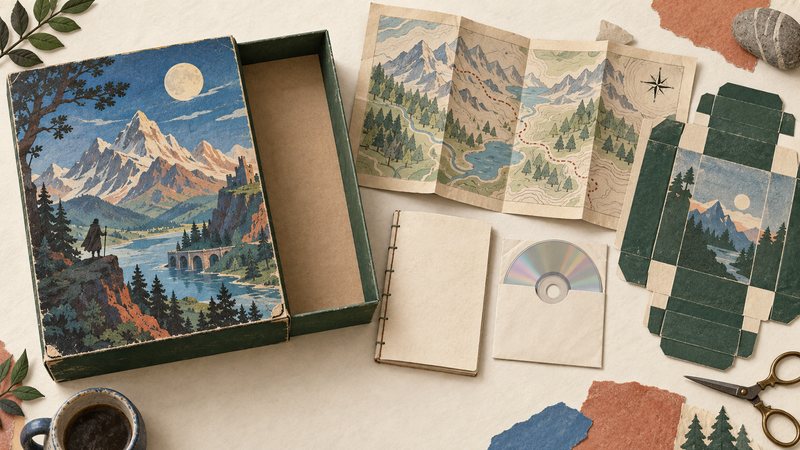
On September 8, GOG added downloadable box scans and printable artwork for five titles: Star Trek: 25th Anniversary, Armikrog, Descent, Hitman: Codename 47 and Myst. The project, made with Benjamin Wimmer’s Big Box Collection, lets owners examine the packaging as a 3D object or assemble a paper version themselves.
It is a modest addition to a preservation programme. It is also a useful challenge to the idea that a game has been fully saved once somebody gets it to launch.
The bits outside the executable
A working game is the obvious priority. Beautiful packaging cannot rescue software nobody can play. But playability and historical completeness are different achievements.
Imagine finding an old film with its picture and sound intact, but no poster, credits, reviews or evidence of how it was presented to audiences. You could watch it. Understanding its place in the world would take considerably more detective work.
A game’s packaging offers some of that missing evidence. Which screenshot received the most space? Was the pitch about atmosphere, technical spectacle or the number of hours you could disappear into it? What did the publisher think would make a stranger pick it up?
Even the embarrassing promises are useful. The gap between what a box advertised and what the game delivered tells a story that a cleaned-up modern store description might quietly erase.
That does not make every cardboard flap sacred. It makes the decision about what to discard less obvious.
Ars Technica’s report describes the downloads as a ZIP containing a GLB 3D model and printable templates in PDF, SVG and Adobe Illustrator formats. Those are reproductions of packaging, not newly manufactured retail editions. A home printer will not recreate the precise finish or wear of an original box, and no amount of glue turns the result into an original collectible.
For historical access, though, that is fine. A reproduction can answer questions that an unavailable original cannot.
Nostalgia is the invitation, not the whole job
There is a temptation to turn this into another argument that everything was better when games came with enough cardboard to post a toaster.
Wimmer is more interesting than that.
In his September 8 interview, the collector argues that modern storefront cards already perform some of the old box’s work through artwork, screenshots and video. He wants digital libraries to make better room for personal notes, manuals and other material, rather than simply dressing a launcher up as a pretend room full of shelves.
That is a sensible distinction. The goal should not be to make software imitate furniture. It should be to keep meaningful parts of a game together.
Consider a player returning to a complicated role-playing game after six months. A library page that opens their annotated map and last few notes alongside the game would be more useful than a lovingly rendered virtual bookshelf. It would also preserve something the publisher never shipped: that person’s route through the world.
This is a design possibility, not a feature GOG has announced as part of the box release. But it points toward a richer definition of a library. A collection could remember more than purchase dates and time played.
The same care should extend to the people whose work surrounds the software. Cover artists, illustrators and manual designers helped establish what players imagined before the first loading screen. Wimmer’s interview also describes his efforts to identify cover artists. Making those credits easier to find would do more for gaming history than another anonymous folder labelled “bonus content.”
A keepsake is not a preservation policy
GOG benefits commercially from this story. Its preservation work distinguishes its shop from competitors, and a charming extra gives people another reason to revisit a product page. That does not cancel the value of the work. It does mean the attractive packaging should not become the measure of success.
Five downloadable boxes are a beginning, not a comprehensive archive. They do not settle questions about missing versions, unavailable games or the long-term survival of the files themselves. Nor should a 3D scan be mistaken for a promise that every insert from the original release has been digitized.
There is a straightforward standard worth asking for as projects like this grow: tell us which edition was scanned, identify the contributors where possible, say what is missing and let people retain usable copies. A downloadable object is valuable partly because it need not remain trapped inside one website’s display case.
For future releases, publishers could make that work easier by assembling the archive while the credits, artwork and release materials are still close at hand. It seems considerably kinder than leaving someone in 2056 to reconstruct everything from auction photographs.
None of this requires giving up instant downloads or pretending we miss hunting for a misplaced disc. Convenience is a genuine improvement. The mistake was assuming that everything convenience removed was irrelevant.
The box may have contained mostly air. It was never entirely empty.