
A smart home sounds wonderful in theory.
Lights that turn on automatically.
Thermostats that learn your habits.
Voice assistants that answer questions and control your devices.
Technology working quietly in the background while life becomes a little easier.
At least, that’s the promise.
The reality is often far less elegant.
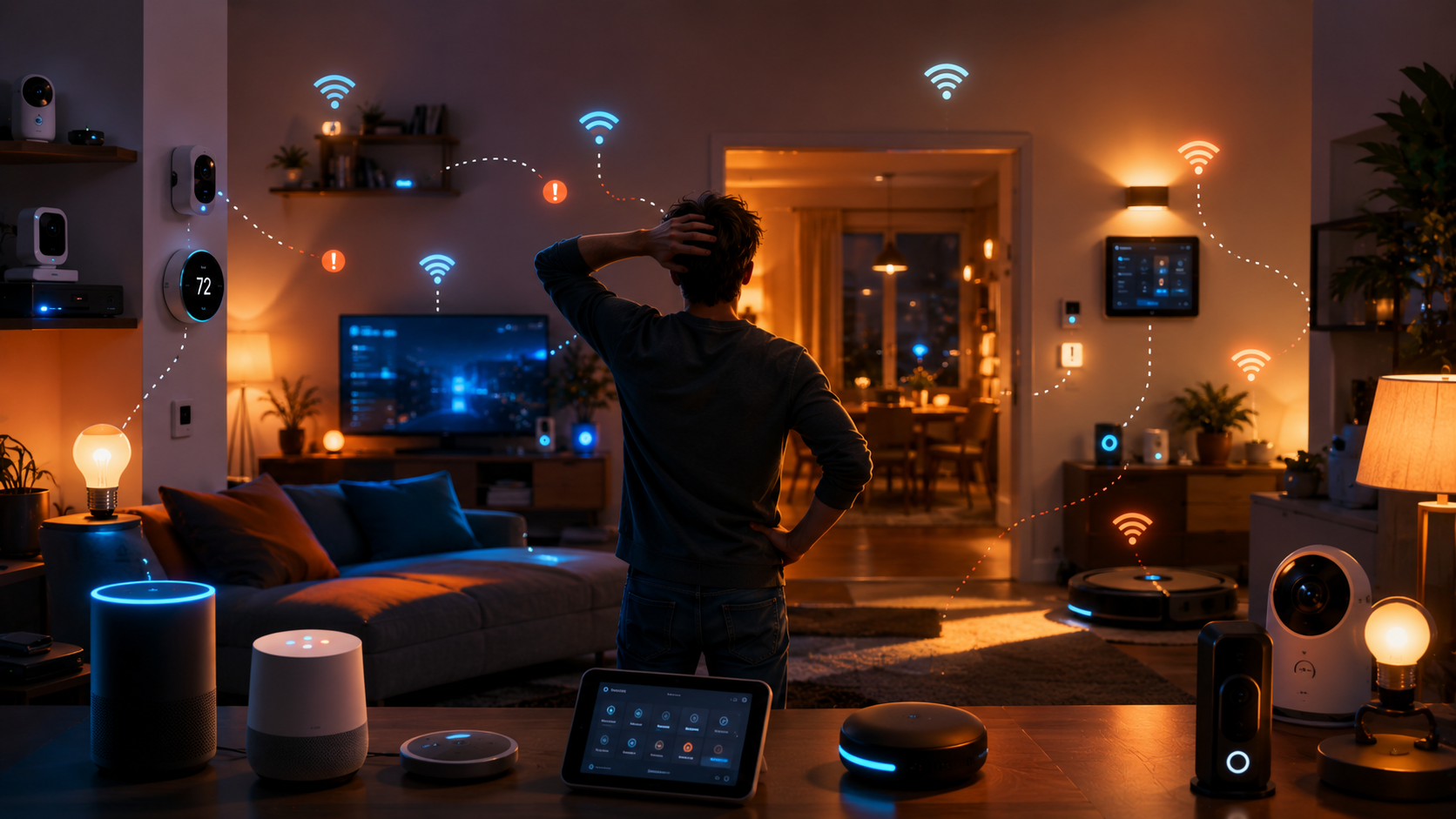
Anyone who has spent time building a smart home has probably experienced the same moment. A voice command suddenly stops working. A device disappears from the network. An automation that worked perfectly yesterday decides to fail for no apparent reason.
The smart home isn’t broken.
It’s just being a smart home.
For years, technology companies have marketed connected devices as simple solutions to everyday problems. Buy a smart bulb, connect it to an app, and you’re done.
Until the app changes.
Or the Wi-Fi changes.
Or the manufacturer discontinues support.
Or a software update introduces a new issue.
What many people discover is that smart homes are often less about automation and more about maintenance.
In some ways, we’ve accidentally created tiny IT departments inside our own houses.
The problem isn’t that the technology is bad.
In fact, many smart home products are remarkably capable.
The problem is that most systems were never designed to work together.
One company builds your lights.
Another builds your thermostat.
A third company builds your cameras.
Each device works well individually, but connecting them into a seamless experience often requires patience, research, and occasional troubleshooting.
Ironically, the people who enjoy smart homes the most are often the people who enjoy solving technical problems.
For everyone else, the experience can feel frustrating.
Yet despite all of this, the idea of the smart home remains compelling.
Because when everything works, it feels a little magical.
Lights adjust automatically.
Doors lock themselves.
Temperatures stay comfortable.
Technology fades into the background.
And that’s the real goal.
The smartest homes aren’t the ones with the most gadgets.
They’re the ones that require the least attention.
The future of smart homes likely isn’t about adding more devices.
It’s about making existing devices disappear into the experience.
When technology becomes invisible, that’s when it finally becomes smart.
Until then, many of us will continue spending our weekends explaining to a light bulb why we’d like it to turn on.